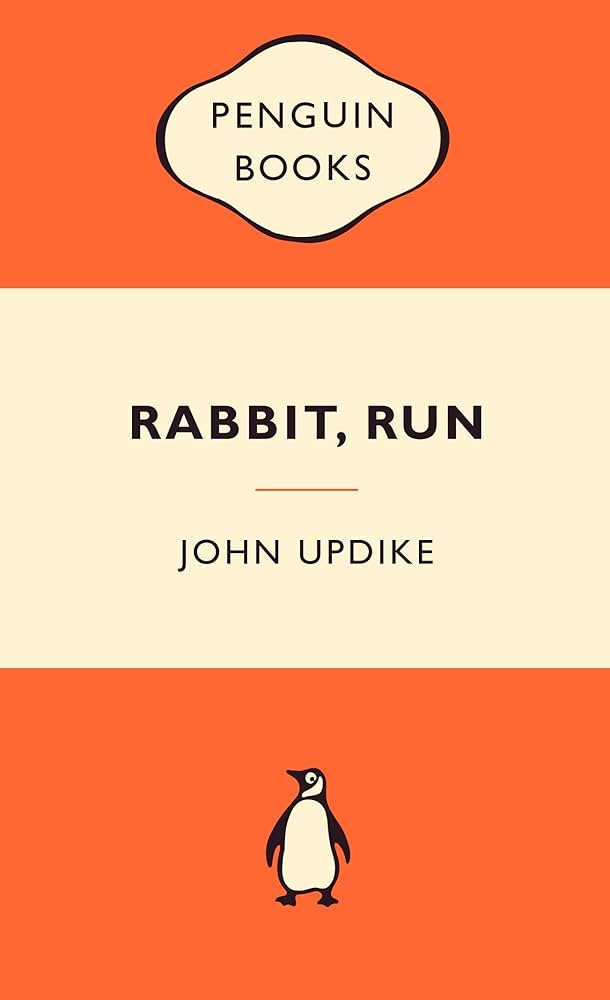
On the Novel Rabbit, Run by John Updike
Source: Rabbit, Run, 51st printing, Fawcett Crest, New York, 1982
Introduction
Rabbit, Run was first published in 1960 and is part of the tetralogy that also includes Rabbit Redux, Rabbit Is Rich and Rabbit at Rest. In this paper, however, it will be treated as a separate novel and not as part of the tetralogy.
The protagonist of the novel is Harry Angstrom. In the course of this paper, I will try to explore and identify the kind of conflict he experiences, what he is looking for and whether he finds it or not. In doing this, I will see his actions and thoughts in the novel from an existentialist perspective, using three different existential philosophers: Søren Kierkegaard, Gabriel Marcel and Jean-Paul Sartre. Kierkegaard as the father of existentialism; Marcel and Sartre as representatives of Christian and atheist existentialism, respectively. I regard this division as necessary, because their views are quite different, sometimes contradicting. I will select from them what I think is relevant in connection with the novel.
I will focus mainly on three scenes. The first is the home scene, before he runs away. This will be dealt with in some detail, because it is what triggers off Harry’s existential conflict. Next is the Kruppenbach scene, because he is the only person with a dedicated and confident view of life, providing us with an alternative to the other people trying to tell Harry what to do. Finally, I have chosen the graveyard scene, because here, it seems, Harry has some kind of vision or insight which might give him what he is seeking.
Existentialism
John Updike is an author who is very much preoccupied with existential and religious questions. He studied the Danish philosopher Søren Kierkegaard extensively, and was also fascinated by the writings of the Swiss theologian Karl Barth (‘crisis theology’ or ‘dialectal theology’).1
When dealing with existentialism, one is immediately faced with a problem of definition. Some even trace existentialism back to the Greek pre-Socratic philosopher Heraclitus,2 but most often, existentialism is regarded as a response to the modern crisis of human existence. Feelings of estrangedness, homelessness, alienation, absurdity are often associated with modern existentialism, and the impression of having been thrown into the world for no particular purpose has often been regarded as its starting point. Existentialism, trying to provide an answer to this situation, is thus an active philosophy about how to live. Reinhardt tries to describe existentialism in this way:
It is the end of philosophy to furnish a way of life rather that to present an abstract doctrine, and [that] the genuine philosopher vouches for the authenticity of his thinking with his existence rather than with his ‘system’.3
Another factor to make it even more difficult, is the fact that you have nihilistic, theistic and aesthetic existentialists.
Anfinn Stigen characterizes existentialism by the following six points:
- The division subject-object. The consciousness is not a passive receiver of sense impressions, but creates its own ideas and is inseparable from them.
- The individual. Only the individual can know anything about what it is like being him/her.
- Man’s awareness of himself as existing. It is an essential ability, but it also leads to anguish.
- The essential choice. Man can make his existence. The criteria are man’s responsibility.
- The sense of anguish, homelessness and finality. In certain situations, we are more open to the truth. When feeling anguish, we see into our own existential situation. We feel burdened by recognizing that only we can do something with our own situation.
- The impossibility of conveying to others essential truths. The truth has to be experienced personally.4
Existentialism has also been regarded as a reaction against Hegel and his universal rationalism, and his reducing theology to superstition and philosophy to a part of the natural sciences.5 Existentialists react to the situation of man in an age which is losing comfortable absolutes:
Whereas a century ago the large majority of Western men were still either convinced Christians or convinced rationalists, the present generation is in the gravest peril of losing both the «tragic optimism of Christianity» […] and the cheerful self-assurance of rationalism. Intimidated by the unexpected sight of the opened abyss of human existence, man finds himself lost in a world which dangerously closes in upon him from all sides, and he laments the seeming absurdity of his situation.6
According to the traditional way of looking at existentialism, it «started» with Søren Kierkegaard (1813–1855) – he is at least viewed as the father of modern existentialism. He provides us with much of what has become general existential terminology. «Kierkegaards main concern is the possibility of man’s self-realization: to what extent, he asks, can man realize himself and save himself by withdrawing from the irresponsibility, superficiality, and the forgetfulness of everyday life?»7 In order to make this possible, Kierkegaard demands «an all-decisive ‘choice’, an unconditional ‘either-or’».8 Kierkegaard wanted honesty above all, even if it led to rebellion against God.
His most famous idea is perhaps his division of man’s consciousness into three stages:
- the aesthetical stage
- the ethical stage
- the religious stage
A modern representative of the Christian philosophy of existence is the French Catholic Gabriel Marcel (1889–1978). He emphasizes the act of faith as the basis for realizing yourself as a human person: «The act of faith thus marks the birth of both human personality and human freedom.»9 He differs from Sartre in, among other things, claiming that man has certain inherent values «incarnate» in «being» as it were. Where Sartre writes that the human choice creates the values, Marcel says that the values determine the choice.10 A summary of his line of thinking is given in Reinhardt:
Once I have freely accepted my human situation and my life has become unified by my fidelity to my vocation as a human person, every one of my acts is organically integrated in the totality of my existence. And it is only in this totality that I acquire my authentic freedom and my full human stature. The refusal, on the other hand, to thus engage and dedicate myself leads to a cumulative loss of both freedom and personality. Authentic freedom manifests itself in choice; it fulfills itself in engagement; and the highest form of engagement is the act of faith.11
Marcel is further preoccupied with what he calls «the ontological mystery» of being.12 The way to approach being is through the individual. He continues:
Man is called upon by being, and he is to respond to this call by a total dedication. […] Man is «a witness» and «bearing witness» is of his very essence.13
In the same tradition, but from an atheistic point of view, French existentialist Jean-Paul Sartre (1905–1980) revived and developed Kierkegaard’s ideas, making them popular and fashionable all over Europe and the USA. His views on existence are more gloomy and, in some ways, without much hope: «Human freedom therefore, is not a blessing, but a curse and a horrible joke,»14 and «Constantly checkmated in his projects, constantly thrown back on his fragile momentary existence, man, in his dereliction (délaissement), experiences dread and anguish.»15
Discussion Of The Novel From An Existentialist Perspective
A major problem when discussing existentialism in Rabbit, Run is the instinctive nature of the protagonist, Harry «Rabbit» Angstrom. His non-reflective, yet often conventional, attitude towards his environment makes it difficult to make the statement that he is an existentialist hero. (The Camusian hero of L’etranger – who could have been a possible parallel – does not have the, though weak, moral scruples of Harry Angstrom. This makes Harry non-reflective but with a capacity for compassion.) Even his nickname contradicts a reflective mind, it seems. It rather gives a feeling of animal instinctive behaviour and also focuses on sexuality as well as cowardice. The rest of his name, however, points in a different direction. If his family name is split up, you get Angst – rom (orig: «røm»). Angst (anguish) is a central term in existential thought, introduced by Kierkegaard. It «results from the fact that man is, as it were, suspended at the danger point between Being and nothingness».16 It is this experience that is the starting point for choosing to live authentically. The last part of the name, however, gives a hint of Rabbit’s reaction to existential anguish: he runs away. The word usually includes the notion of escaping to somewhere, to run in a particular direction, but Rabbit doesn’t seem to have anywhere to run to. The running itself is his escape.
Harry Angstrom’s problems start from the day his career as a basketball star ends, event though we have Tothero, Harry’s basketball coach’s words: «A boy who has had his heart enlarged by an inspiring coach […] can never become, in the deepest sense, a failure in the greater game of life» (Rabbit, Run, p. 62).17 The successful athlete, however, turns out to be an amateur when left alone in the business of dealing with human relations. This is perhaps not the «real» reason for his existential crisis. The basketball experience, however, sums up and symbolizes a view of life, a lifestyle, that is adequate in a game, but that has many weaknesses when the player becomes a part of the complexities of real life. In everyday life, it seems, he meets his existence with the classic symptoms of existential crisis, absurdity being the most significant one. Having established Rabbit’s problems as an existential crisis, the next step should be trying to point out what the crisis consists of, and what makes it existential.
As mentioned before, Rabbit’s crisis is linked with his career as a successful basketball player in high school. It filled his life with meaning and he didn’t need anything else. The game became very much like a religion to him. At certain stages of the game, in certain situations, he would be filled with something similar to the Holy Ghost. An intense experience of being able to handle something, to be in control, knowing that what you do is right and unquestionable:
We go out there and there are these five farmers clumping up and down, and we get about fifteen points up right away and I just take it easy. And there are just a couple dozen people sitting up on the stage and the game isn’t a league game so nothing matters much, and I get this funny feeling I can do anything, just drifting around, passing the ball, and all of a sudden I know, you see, I know I can do anything. (p. 65)
The religious aspect may also be seen in the next scene:
[…] and then afterwards their coach comes down into the locker room where both teams are changing and gets a jug of cider out of a locker and we all passed it around. (p. 65)
This ritual in the locker room rounds off the game, like Communion rounds off the church service.
As many critics have argued, Rabbit is portrayed as a religious character, in spite of his behaviour: «He wants to believe in the sky as the source of all things» (p. 258). He is not an active member of any denomination or indeed in any kind of organization that treats matters of belief or conviction, be they religious, political or philosophical. Nevertheless, he is religious. That is, he has a tendency to reason within the framework of religious ideas. This is, of course, partly due to a traditional American upbringing. But Rabbit has no conscious awareness of this, and this is part of his problem.
Thus far I have only described Rabbit’s religiosity by external factors, but there are also – and far more importantly – internal factors to his religious feelings. They manifest themselves in different ways and with varying levels of intensity. One example has already been mentioned above, in connection with basketball. After this, they take the shape not so much of strictly religious feelings as of a feeling that out there «there’s something that wants me to find it» (p. 120), a longing for meaning and direction, to get a grip on life. This echoes the «it» of Dean Moriarty in Kerouac’s On the Road18. Both Dean and Harry are referred to as mystics, and their thinking is similar in many ways. Perhaps Harry would have been successful as a hipster?
An early episode in the book illustrates how far Harry Angstrom is from coming closer to an understanding of life and of himself that can give him the meaning or the direction he so badly needs. Harry and Janice are watching a TV-programme for children:
Jimmy sets aside his smile and guitar and says straight out through the glass, «Know Thyself, a wise old Greek once said. Know Thyself. Now what does this mean, boys and girls? It means, be what you are. Don’t try to be Sally or Johnny or Fred next door; be yourself. God doesn’t want a tree to be a waterfall, or a flower to be a stone. God gives to each one of us a special talent.» Janice and Rabbit become unnaturally still; both are Christians. God’s name makes them feel guilty. «God wants some of us to become scientists, some of us to become artists, some of us to become firemen and doctors and trapeze artists. And He gives to each of us the special talents to become these things, provided we work to develop them. We must work, boys and girls. So: Know Thyself. Lear to understand your talents, and then work to develop them. That’s the way to be happy.» He pinches his mouth together and winks. (pp. 14–15)
From this passage we learn that both Harry and his wife are Christians. They are feeling guilt at the mention of God, because their religion is passive and non-reflective, really just a habit. The Mouseketeer, though representing Americanized, simplified, maybe even misinterpreted philosophy, does express some wisdom about life, but it is completely wasted on Harry. In a sense, Harry has done exactly what the Mouseketeer tells him to. He found his talent, developed it and had some success. But now his talent is past its prime and of no use to him anymore. But when the Mouseketeer says «Know Thyself» and «be what you are», it could also be taken to mean accept yourself. Don’t try to be something you’re not. This is, in fact, right at the heart of Harry’s crisis. Harry refuses to accept himself and the situation as it is at the beginning of the novel. He tries to pretend that things will be alright sometime in the future. Here he sins against one of the basic existentialist decrees, as expressed by Gabriel Marcel:
I transcend the fleeting moment by exercising my freedom in a threefold «engagement»: in confronting my present, in accepting my past, and in projecting my future. By thus affirming myself in the continuity of my personality I oppose myself to the featureless collective (Heidegger’s «der Mann»). In the perspective of the impersonal «Man» I cannot confront my present, I rob myself of my past, and I cannot build my future.19
Harry is more interested in how the performance may give him ideas as to how he may be able to sell more MagiPeelers.
All these contradictory and problematic emotions make Rabbit do what he’s good at: run. In the early part of the book we join him on his journey by car to nowhere. This is the first desperate reaction to the intolerable existential situation he has found himself to be in the middle of.
The pretext for his escape is the situation we are presented to at the beginning of the novel. After a description of Harry playing basketball with some kids in the street on his way home from work, we are introduced to what appears to be the usual weekday afternoon in the Angstrom house. We get a feeling of utter dissatisfaction on Harry’s part. On his way home, change is in the air. «The month is March. Love makes the air light. Things start anew» (p. 11). Having noticed how easily he got winded after playing basketball with the kids, he spontaneously quits smoking. With this optimistic attitude, full of good intentions, he meets his wife and son in their home. We see, however, very soon that this family has deep problems. Harry’s wife has been drinking – as usual, it seems – and no housework has been done, no dinner is ready. As an «order-loving man» (p. 13) he is very provoked by the state of the house. Harry also has a very ambivalent relationship to his wife:
Just yesterday, it seems to him, she stopped being pretty. With the addition of two short wrinkles at the corners, her mouth has become greedy; and her hair has thinned, so he keeps thinking of her skull under it. These tiny advances into age have occurred imperceptibly, so it seems just possible that tomorrow they’ll be gone and she’ll be his girl again. (p. 13)
These thoughts say, perhaps, as much about Harry as they do about her. Being 24 years old, there are natural limits to the degree of decay she cane possibly have gone through. And though he thinks to himself: «There seems no escaping it: she is dumb» (p. 17), she has a notion of what he’s about to do, even before he knows it himself: «Don’t run from me, Harry. I love you» (p. 16). In addition to her alleged dumbness, he is disgusted by her drinking habits: «He can feel the undertow of liquor sweep over her and is disgusted» (p. 16). Even the fact that she is pregnant again seems to disturb Harry: «[…] her pregnancy infuriates him […]» (p. 15). His feelings about children have also been indicated earlier in connection with the kids playing basketball: «The kids keep coming, they keep crowding you up» (p. 9). This is not only due to his frustration at responsibility, it also adds to his feeling of being tied to a situation, a life that is not even close to what he wants it to be. The reflection also gives the feeling of how generation after generation follow each other, masses of people struggling with the same problems, the same worries, and no end to it. The world is full of people, people you will never know or understand, and they again are limited to their little piece of what they consider to be reality.
However, the description of his relationship with their son Nelson does not give any evidence of Harry not loving his son. It is rather the whole situation, the future he can see ahead of him, that makes him run away. And, even if Harry says that the same scene that we are witnessing in the Angstrom house in the beginning of the novel has happened «a couple hundred times. Maybe a thousand times» (pp.17–18), it is important to see this situation as the one that makes Harry run away. This is the limit of what he can stand. What he later tells Eccles about the reason being Janice asking him to buy her a pack of cigarettes, is, of course, a joke – if not a terribly good one.
The cigarettes remind him of his whole situation as she calls after him on his way to pick up Nelson. They symbolize the unhealthiness he feels quite physically of his position. «He wonders how anybody could think of smoking, with his stomach on edge the way it is» (p. 14). With this disgust in him, Harry leaves to pick up Nelson at his mother-in-law’s, whom he despises. His own mother is not much better. He hates her talk «about how incompetent Janice is» (p. 19). Getting the message about the cigarettes, signalling that everything is as before, «Rabbit freezes, standing lookin at his fain yellow shadow on the white floor that leads to the hall, and senses he is in a trap. He goes out» (pp. 19–20).
As Harry is leaving the house, he is well on his way into an existential crisis resulting from a feeling of leading an absurd life, illustrated by the family situation recounted above. He seems to feel, in a way, too good for his family. Nobody understands him – a frustrating fact for a person who does not understand himself too well either. The only one he thinks of with warm feelings, is Nelson. However, he has not yet even thought of deserting his family.
It is not stated explicitly when he decides to run away. But his walk from his home to the car – passing and spying on his parents’ home – has the character of a good-bye. He thinks back to his seemingly happy childhood and touches objects on his way, as if seeing them for the last time. He walks downhill, perhaps signalling a negative development. On the way, he gives a description of the forests around Mt. Judge:
Much of it is penetrated by the sound of cars climbing the scenic drives in second gear. But in long patches of forgotten pine plantation the needle-hushed floor of land glides up and up, on and on, under endless tunnels of dead green, and you seem to have passed through silence into something worse. And then, coming upon a patch of sunlight the branches neglect to keep or upon a softened stone-filled cellar pit dug by some brave and monstrous settler centuries ago, you become vividly frightened, as if this other sign of life will call attention to yourself, and the menace of the trees will become active. Your fears trills like an alarm bell you cannot shut off, the louder the faster you run, hunchbacked, until distinctly, with a gasp of the clutch, a near car shifts gears, and the stumpy white posts of the guard fence dawn behind the pine trunks (p. 22).
This can be seen as a description of existential anguish, or the moment, as Kierkegaard also calls it. This is a state in which the individual sees the paradox of being both finite and infinite and senses his complete isolation from the rest of the world.20 The description starts out with «scenic drives» and ends with a feeling of nature attacking you. Part of «the moment» is also the recognition of choice as a completely individual activity, and also a recognition of the choice as extremely difficult and with consequences for the individual.
Later, he remembers climbing telephone poles as a kid: «Listening to the wires as if you could hear what people were saying, what all that secret adult world was about» (p. 20). He still does not know ‘the secret’, and is haunted by the urge to find out. He feels isolated, as when he stealthily observes Nelson eating supper with his parents and his sister. He observes them through a windowpane, echoing his description of his feelings when his parents quarrelled when he was a boy: «[…] when their faces went angry and flat and words flew, it was as if a pane of glass were put in front of him, cutting off air; his strength drained away and he had to go to a far corner in the house» (pp. 24–25). Here we also recognize the way in which Harry deals with conflicts – he loses all strength and moves away from it. Watching them adds to his feeling of failure and alienation: «[…] this home is happier than his […]» (p. 26). From this point a decision seems to have been made: «His acts take on a decisive haste» (p. 26). He leaves to get the car, but when he discovers that he has forgotten the key, he reveals that he is planning something: «Everything depends, the whole pure idea, on which way Janice was sloppy» (p. 26, italics mine). Here he seems to have taken some kind of decision that now depends upon whether Janice has left the keys in the ignition or not: she has.
From this point on, Harry’s internal conflict has external consequences, and he starts out on what may be seen as a quest for truth, for meaning to his life. He more or less consciously tries out different alternatives, all with – at least seemingly – negative results. His escape by car leads back to the starting point – even though he never intended to see Brewer again – leaving him no wizer (p. 27). During the escape, we see how Harry lets arbitrary symbols determine the way: Route 100 sounds ultimate; road 23 reminds him of a particular baseball game (p. 29). He has no other source of direction, as the man at the filling station points out: «The only way to get somewhere, you know, is to figure out where you’re going before you go there» (p. 32). Later, in a roadside café, Harry gets, for the first time, described explicitly, a concrete feeling of alienation. He wonders if he is outside «all America» (p. 36). Using many variants of net imagery, Updike shows how Harry is tied to his past and to his hometown, how it is a part of him and a limitation to his actions. His conscience is also a limit – escaping makes him feel like a criminal (p. 31). Physical escape does not provide a solution.
Then he tries sex as a way of getting in touch with the «something» he knows exists. This has worked before, he remembers, thinking back to his high-school days when he used to end a day of playing basketball with sex. But, as his basketball days are gone, so is the magic of sex, it seems, even if he does experience, with Ruth, some sort of closeness and a feeling of being in touch with something eternal and good. The experience is, however, short in duration, and does not give him what he seeks. «Nothing is closer to despair, that is, closer to the refusal to exist and closer to suicide than a certain way of celebrating life as it is embodied in the pure instant» (p. 21). After their first sexual experience together, where he «sees her heart» (p. 82), he ends up staring at the horizontal strip of stained-glass church windows that shows under the window shade. Its childish brightness seems the one kind of comfort left to him (p. 84). Again, our attention is turned toward religion, even though he, in a way, admires «[…] Ruth’s blue-eyed nothing, the nothing she told him she did, the nothing she believes in» (p. 93). The next morning, he actually prays:
Help me, Christ. Forgive me. Take me down the way. Bless Ruth, Janice, Nelson, my mother and father, Mr. and Mrs. Springer, and the unborn baby. Forgive Tothero and all the others. Amen (p. 87).
Working as a gardener, he gets closer to what he is seeking. Nature is far easier to relate to and deal with than human beings: «[…] for example, when the gardener cultivates his garden […]: the dualism of the possessor and the possessed disappears in a new living reality»23 – but still, it cannot provide a satisfactory answer to his longings.
Jack Eccles, the minister who tries to give Harry what he is looking for, is shown to be so far from a meaningful existence himself that he is not a realistic alternative to the absurdity Harry experiences. He is often characterized as horizontally oriented, as opposed to Harry’s upward orientation. There are also hints of him not believing in God at all: «[…] I don’t believe in anything» (p. 247), and: «Harry, you know I don’t think that thing exists in the way you think it does» (p. 259). However, it seems that Eccles is quite comfortable being an atheist minister, doing social work instead of leading people to God. He has, in a way, accepted the situation and makes the best of it, but we get a feeling that it cannot last. One day the paradox will come to the surface, and he will have to deal with it.
Eccles is eventually confronted with his absurd situation in the course of the book, namely in his meeting with Kruppenbach, Harry’s nominal pastor. According to Updike himself, Kruppenbach is «the touchstone of the novel as I intended it. His life, including the motorcycles, is meant to be Barth in action»23. Even if the author’s intention is disregarded, the importance of Barth to Updike and the scene in its own right suggests that it carries great weight as to the theme of the novel. This meeting «deserves more attention, for it reveals an unflinching faith that could have fleshed out Harry’s vague belief in the Beyond»24. Kruppenbach, then, is the complete opposite of Eccles. Where Eccles represents dead faith, a transforming of the role of minister into that of a social worker, Kruppenbach’s faith is warm, almost frying. He is disgusted with Eccles’ interpretation of the minister role, and insists that he should be saving people for God. A ministers cause is a much higher one than meddling with trivialities like people’s personal problems. As Eccles explains his theories as to what the problems between the various members of the Springers and the Angstroms are, Kruppenbach is not even listening. He accuses Eccles of believing that his job is to»to be an unpaid doctor, to run around and plug up the holes and make everything smooth» (p. 158). He continues:
If Gott wants to end misery, He’ll declare the Kingdom now […] I say you don’t know what your role is or you’d be home locked in prayer. There is your role: to make yourself en exemplar of faith […] There is nothing but Christ for us. All the rest, all this decency and busyness, is nothing. It is Devil’s work (p. 159).
This conversation being between Kruppenbach and Eccles instead of directly with Harry, may reflect Kierkegaard’s idea about indirect communication, i.e. how essential truths cannot be explained, but may only be grasped in a dialectical way. If one sees Kruppenbach as representing Barth, a great deal can be made of this scene,25 but for our purposes it will suffice to see Kruppenbach as representing Kierkegaard’s either-or, as opposed to Eccles’ lukewarm middle way. Kruppenbach thus provides a once-and-for-all choice that could have guided Harry in his clumsy attempts at arriving at something lasting. It also shows the weakness and insecurity of Eccles, who feels like a scolded child after being reprimanded by Kruppenbach. In Sartre’s view, Eccles and Kruppenbach represent two ways of dealing with reality that are both false. This is how man meets his freedom, according to Sartre:
He would like nothing better than than to rid himself of this burden, by shifting responsibility for his actions either to the determining forces of environment and heredity or to the decree of a superhuman power: by becoming either a non-conscious and non-responsible being or a being subject to a superior law and necessity. But such attempts to escape – materialistic determinism as much as religious predestination – are essentially dishonest (de mauvaise foi) and foredoomed to failure.26
In this scene, however, Kruppenbach’s attitude is portrayed as the most positive one. He has a power that almost crushes Eccles.
The scene also shows how, to Eccles, existence is a problem that needs to be solved, as opposed to Harry, «the mystic», for whom it is a mystery to be explored. This has a parallel in Marcel’s thinking:
The union of body and soul, the phenomena of evil, of love, of freedom – they all pose no problems: they are mysteries. They «envelop» me; I am enclosed in them. It is equally improper, according to Marcel, to speak of the «problem of being»; there is only a «mystery of being».27
When we get to the graveyard scene, Harry has given up his project of escape, and is back with Janice, playing the repenting husband who has decided to be responsible and mature. This is to a great extent a result of Janice having their second baby and his feeling of responsibility in that connection. Harry’s determination, however, is not whole-hearted and he is by no means at peace with the new situation – which is pretty much the same as before, if not worse.
The graveyard scene is also, of course, the burial of the child he returned home to be responsible for. The problem of guilt in connection with Rebecca’s death is in many ways revealing. Here Eccles shows his mastery in playing the social worker Kruppenbach so detested. Thus when we get to the actual burial, everybody – silently or explicitly – has agreed on shared guilt. It’s a «bargain» (p. 252). Harry’s second thought, after blaming himself, was to blame God: «[…] in all His strength God did nothing. Just that little rubber stopper to lift» (p. 255). Almost everybody, however, is shown to really blame Harry. It is just out of mercy and a wish for Janice and Harry to get over it that they agree to share it. Harry senses this and is shown really to prefer condemnation. At one point, where he is unreasonable towards Janice at the Springers’, «The house again fills with the unspoken thought that he is a murderer. […] hate suits him better than forgiveness. Immersed in hate he doesn’t have to do anything; he can be paralyzed» (p. 263). Later, when Springer Telles him there won’t be a charge of manslaughter, «It disgusts him to feel the net of law slither from him. They just won’t do it for you, they just won’t take you off the hook» (p. 264). It seems as if Harry would prefer being declared guilty instead of being understood and expected to behave decently in return. As guilty, he would, in a way, be free of responsibility.
At the funeral parlour, Harry feels more and more remote and different from the others, referred to by Harry as «human beings» (p. 268). He feels that «the outer world bears a decreasing relevance» (p. 269). We get a notion of him rising above the others: «[…] his tall cool height […]» (p. 268). When Eccles reads the words of the Bible, Harry is the only one really listening: «[…] he feels their possibility. Eccles doesn’t […]» (p. 269). Eccles is described as standing between Harry and his daughter. He senses the falseness in Eccles and in the people around him. Only the dead daughter isn’t false; she knows.
They drive uphill to the cemetery, perhaps as a signal that we are spiritually moving into another level. Eccles reads more from the Bible at the grave, and Harry is sure that Rebecca has ascended to Heaven. This «fills Eccles’ recited words like a living body a skin» (p. 270). After Eccles has said a prayer, Harry has an intense feeling of unity with everything around him, animate and non-animate. He is on his way to reaching the ultimate truth, it seems: «The sky greets him. A strange strength sinks down into him. It is as if he has been crawling in a cave and now at last beyond the dark recession of crowding rocks he has seen a patch of light» (p. 271). This is a variant of Plato’s parable about the cave, and Harry is described as catching a glimpse of the ideal, according to Plato: «The thing behind everything» (p. 259). But «the rocks» can also be interpreted as the gravestones, thus making the patch of light represent an after-life, eternity. In this state of grace and forgiveness, of realizing the unimportance of guilt and «Casting every care on thee …» (p. 271), Harry says the cruel truth: «Don’t look at me … I didn’t kill her», and «You all keep acting as if I did it. I wasn’t anywhere near. She’s the one» (p. 271). Seeing that they are shocked at this, he tries to explain that he «just wants it straight»: «Hey, it’s OK … You didn’t mean to» (p. 271). But they do not understand, they «misunderstand». He has broken the agreement of shared guilt and said what was not to be said. He can face the truth, but the others cannot. The others, and especially his wife, not wanting to see the truth, denying it, make his forgiveness turn into hate. «A suffocating sense of injustice blinds him. He turns and runs» (p. 272).
What is it that he experiences during the burial? It seems to have more to do with pure religion than with existentialism, or a combination of the two. It seems, at least, that he is finally in touch with what he has been searching for. But the consequences are negative. Why, then, can something that is good – truth – lead to such consequences? This reflects what has been maintained through the novel, the notion that Harry is «too good», even if it has some ironic overtones. It is also reflected in what Updike says the novel is about: «[…] my work says ‘Yes, but’. Yes, in Rabbit, Run, to our inner urgent whispers, but – the social fabric collapses murderously».28 In this light, what Harry has found will be of no good to him. The «social fabric» cannot function when exposed to the truth. Realizing this, Harry instinctively runs away. In doing so, he is again attacked by nature, and the «scenic drive» is referred to, in which anguish was encountered before.29 His vision is thus receding and he is losing his grip: «He begins to doubt his method» (p. 274). He is, however, certain that «[…] he has put her [Rebecca] in Heaven, he felt her go» (p. 277).
Turning to Ruth, he is not met with understanding there either. She calls him «Mr. Death». He too senses that his behaviour has negative consequences: «His hands and legs are suffused with a paralyzing sensation of reality; his child is really dead, his day is really done, this woman is really sickened by him» (p. 279). She gives him the ultimatum he so detest; he likes «things to happen of themselves» (p. 281). He becomes utterly confused again and runs away from her too, for the second time. The final sentence of the novel, «[…] he runs. Ah: runs. Runs», reflects Sartre’s view of existence:
«To exist» means for man to realize himself in action, to storm ahead toward an impossible goal. Although he knows that all his projects are destined to suffer shipwreck, although he knows that he spends himself in vain, he is condemned to continue in activities which constantly annihilate his past, his present, and the projects of his anticipated future. Man, in short, is «condemned» to a freedom which weighs upon him like an inescapable fate.30
Accordingly, Rabbit, Run ends on a note of disharmony and confusion.
Concluding Remarks
Returning to the title of this paper, «Harry Angstrom – Existential Hero?», to answer it, the answer will have to be in the negative. Harry Angstrom is not an existential hero. He has neither the consistency nor the awareness to proclaim himself the hero of any ideology. His search for truth, however, is real and praiseworthy enough. The conclusion he arrives at, or that we may see him arriving at, is quite disturbing, unfortunately. The answer the novel as a whole gives – if one can speak of such a thing – would have to be something like a middle way. Truth at any price is not worth it, the consequences are too destructive. The «either-or» is held up as an ideal, but society cannot handle the lack of will to compromisze entailed by it. The disturbing end is thus due to the notion that truth and reality cannot coexist without compromise, it will cause society to fall apart.
Notes
1. Kurt F. Reinhardt, The Existentialist Revolt (New York, 1952), p. 16.
2. Ibid., p. 19.
3. Reinhardt, p. 22.
4. Anfinn Stigen, Tenkningens historie, vol. 2 (Oslo, 1983), pp. 799–801, my translation.
5. Reinhardt, p. 2.
6. Ibid, p. 9.
7. Ibid, p. 16, cf. Harry Angstrom.
8. Ibid., p. 5.
9. Ibid, p. 208.
10. Ibid, p. 211.
11. Ibid., p. 212.
12. Ibid., p. 216–217.
13. Ibid., p. 221–222.
14. Ibid., p. 161.
15. Ibid., 162.
16. Ibid., p. 54.
17. Further references to this novel are given after quotations in the text, without title.
18. Jack Kerouac, On the Road (New York, 1976), pp. 127, 208.
19. Reinhardt, p. 211.
20. Stigen, p. 683.
21. Reinhardt, p. 211. From Marcel Gabriel, Être et avoir, p. 290.
22. Ibid., p. 221, cf. Être et avoir, pp. 225, 239 ff.
23. George W. Hunt, S.J., John Updike and the Three Great Secret Things: Sex, Religion and Art (1980), p. 43.
24. Edward P. Vargo, Rainstorms and Fire (New York, 1973), p. 71.
25. See Hunt, chapter 1.
26. Reinhardt, p. 162.
27. Ibid., p. 215.
28. Hunt, p. 20.
29. See this paper.
30. Reinhardt, taken from Sartre, L’être et le néant, p. 565.
Bibliography
Primary sources:
Updike, John, Rabbit, Run, 51st printing, Fawcett Crest, New York, 1982
Secondary sources:
Brenner, Gerry: «Rabbit, Run: John Updike’s Criticism of the ‘Return to Nature’», in Macnaughton
Burhans, Jr.: «Things Falling Apart: Structure and Theme in Rabbit, Run«, in Macnaughton
Detweiler, Robert, John Updike, Dwayne Publishers, Inc., New York, 1972
Hamilton, Alice and Kenneth, The Elements of John Updike, William B. Eerdmans Publishing, Michigan, 1970
Hicks, Granville: «A Little Good in Evil», in Macnaughton
Hunt, George W., John Updike and the Three Great Secret Things: Sex, Religion, and Art, William B. Eerdmans Publishing Company: [n.p.], 1980
Macnaughton, William R., Critical Essays on John Updike, G.K. Hall and Co., Boston, 1980
Markle, Joyce B., Fighters and Lovers: Theme in the Novels of John Updike, New York University Press, New York, 1973
Mizener, Arthur: «Behind the Dazzle Is a Knowing Eye», in Macnaughton
Newman, Judie, John Updike, MacMillan Modern Novelists, London, 1988
Petter, H.: «John Updike’s Metaphoric Novels», in Macnaughton
Reinhardt, Kurt F., The Existentialist Revolt, 2nd ed., 7th printing, Frederick Ungar Publishing Co., New York, 1972
Stigen, Anfinn, Tenkningens Historie, vol. 2, Gyldendal Norsk Forlag, Olso, 1983
Tanner, Tony, City of Words: American Fiction 1950–1970, Jonathan Cape, London, 1971
Vargo, Edward P., Rainstorms and Fire: Ritual in the Novels of John Updike, Kennikat Press, New York, 1973
 John Eriks hjemmeside